
THE STRIPPING BARE The logical evolution from Kant to Trump (or the collapse of universalism)
ESSAYS OF THE ANTI-UNIVERSALIST / 1

From Kant’s universal “Reason” to Trump’s political dadaism. How the moral exhaustion of the West led us into a materialist blind alley where power is exercised without alibis, and technology, stripped of transcendence, reflects back the diabolical image of our own nihilism.
The morality of the Western Enlightenment initially fashioned itself as a universalist humanism. Kant, for instance—following in Rousseau’s footsteps—helped forge the philosophical foundations of this attitude in Toward Perpetual Peace(1795). Yet, despite the philosopher’s excellent intentions, elevating a particular worldview to the status of a universally valid “Reason”—through its relentless friction against foreign spiritual structures—has driven Western modernity to where it stands today: a civilization hollowed out of any moral force of its own, relying solely on the deployment of propaganda, control, and violent imposition. The canonical explanations offered by the Western “Left” and “Right” were merely the two ideological vehicles through which this violent universalism was articulated. Today, it is all in plain sight. The last to grasp the horror of this recognition are the misinformed masses of the West itself, who are nevertheless beginning to repudiate everything this pseudo-universalist humanism truly represents. The rejection by the American Democratic base of Israel and the war in Iran, alongside the collapse of MAGA and its clash with Trump himself over these very same causes, reveals a crucial convergence: there is, at least in the United States, a conscious resistance to globalism and its inherent supremacism. It is a resistance unwilling to tolerate further massacres in the name of any supposedly “supreme” civilizational value, even though today this resistance, betrayed from above once more, has been left in the wilderness, stripped of any political representation or leadership.
The Mirage of Abstract Reason
In 1795, Immanuel Kant wrote his Zum ewigen Frieden. Ein philosophischer Entwurf, variously translated as “For Perpetual Peace,” “Toward Perpetual Peace,” or simply “Perpetual Peace.” The text outlines the philosopher’s vision of the forms every state must adopt to ensure global peace. In the second section, he prescribes a “republican” constitution as mandatory for every nation on earth. He is referring not to who holds power (which can be autocratic, aristocratic, or democratic), but to how the government is organized. In a republican government (an ideal one, naturally), the laws cannot be created by the very power that applies them. The opposite of republicanism would be despotism, where the genesis and application of laws coincide in those wielding direct power.
Thus, the philosopher of Western modernity imposes his blueprint upon the entire globe, rooted in the premise that Reason is singular and applies equally to all human beings. This relies on an abstract concept of reason that boldly disregards foundational beliefs, linguistic differences, hermeneutical traditions, or the ritual fabric of a community, ignoring how deeply inherent these elements are to what is deemed rational in each of the nations subjected to this claim of universality. It also turns a blind eye to the fundamental untranslatability of one culture into another, even if their vocabularies can be decoded.
Regardless, Kant’s text serves as a glaring example of how Western “Reason” transforms into a presumed universal guide for conduct, placing the ways of life and organization of all others under the judgment—and eventually, the coercion and punishment, something Kant certainly did not intend—of whoever happens to be interpreting this universal “Reason” at the time. Namely, the Western executors of power. Modern rationalism—rooted in Anglo-Saxon thought and deeply influential on Kant through Hume—sought to ground everything in the particular individual and his relationship with “reason,” which in itself is merely a minimal abstraction of the totality of consciousness. From there to Nietzschean nihilism lies only a single step of further desperation. “That there is no truth; that there is no absolute state of affairs, no ‘thing-in-itself.’ This, alone, is nihilism, and of the most extreme kind.” So writes Nietzsche in The Will to Power, defining nihilism and his own—equally desperate—critique of the state of affairs to which Western Modernity would lead as an anti-tradition project.
Kant sensed the danger of reducing the real to the formulable, introducing into his transcendental idealist edifice the concept of the “thing-in-itself” as the paradoxical mystery of the unknowable real. Kant also knew the anxieties of wagering everything on “Reason,” and the arrogance of attributing to others a lack of rationality that he demanded first for his own people. He issued warnings, employing nevertheless the ethnocentric language that betrays the limits of all human formulation. He wrote:
“When we see the attachment of savages to their lawless freedom, preferring continual fighting to subjection to a lawful constraint which they might establish for themselves, preferring senseless freedom to rational freedom, we look upon it with deep contempt as barbarism, coarseness, and a brutish degradation of humanity. One would think that civilized peoples (each united in a state) would hasten all the more to escape, the sooner the better, from such a depraved condition. But, instead, each state places its majesty (for it is absurd to speak of the majesty of the people) in being subject to no external juridical restraint, and the splendor of its sovereign consists in the fact that many thousands stand at his command to sacrifice themselves for something that does not concern them in the least, without his himself being exposed to any danger. The chief difference between European and American savages lies in the fact that many tribes of the latter have been eaten by their enemies, while the former know how to make better use of their conquered than to dine off them; they know better how to use them to increase the number of their subjects and thus the quantity of instruments for even more extensive wars.”
This critique and irony from Kant regarding “civilized” European conduct (though this passage is sometimes cited as proof of the opposite) shows the philosopher understood that cruelty and the dominion of power, violence, and expediency, are not the exclusive property of “savages.” More importantly, Kant openly proclaims the need for an external set of laws, standing above the particularisms of “the States,” to defend Man against these arbitrary “majesties.” But upon what firm rock would these supposed laws, superior to all traditions, rest, if not on the strongest power? The only answer offered was an appeal to “dialogue” and “reason,” which, over time, have proven utterly impotent unless anchored in genuine “good faith”—a concept historically alien to politics.
Kant had also warned of the risk of the West behaving like an oblivious brute toward others, knowing and denouncing its own history. Commenting on the necessity of establishing a right to universal hospitality, by which any peaceful foreigner “keeping to his place” must be respected when visiting a strange land, Kant writes:
“If we compare with this the inhospitable conduct of the civilized states of our continent, especially the commercial states, the injustice which they show in visiting foreign lands and peoples (which is equivalent to conquering them) is terrifying. America, the lands inhabited by the Negro, the Spice Islands, the Cape, etc., were at the time of their discovery considered by these civilized intruders as lands without owners, for they counted the inhabitants as nothing. In East India (Hindustan), under the pretense of establishing economic undertakings, they brought in foreign soldiers and used them to oppress the natives, excited widespread wars among the various states, spread famine, rebellion, perfidy, and the whole litany of evils which afflict mankind.” Following this, the philosopher highlights and justifies that China and Japan, “who have had experience with such guests, have wisely refused them entry.”
The Alibi of the Non-Controvertible Space
The dismissal of the majority of non-individual human factors, in the name of a supposed logical comprehension of “universal reason,” is precisely what other Western philosophers would soon subject to critique.
Hegel made this critique quite early, noting that the West ignores that rights are not born from abstract reason, but from particular civilizations. European power, assuming its own Spirit to be the only legitimate one, attempted to interpret the entire world. The English, subsequent holders of civilizational leadership, arranged the totality of the Other into pyramidal pigeonholes under the theoretical organization of Herbert Spencer and Charles Darwin. Curiously, London remained at the top of the pyramid, which begins with the most primitive and savage and culminates in the House of Lords.
After Hegel, Marx gave the problem a new twist (especially in “On the Jewish Question”), revealing the mechanism by which the particular interests of a group or class are presented as universal. According to Marx, the rights to liberty, property, and security, which the West peddles as universal, are in reality the necessary juridical framework for modern capitalism to function. “Liberty” is the liberty to trade; “property” is the protection of the means of production; “security” is the police protecting the property owner. The problem is that Marx’s critique implies a new universalism, by replacing the interests of capital with the interests of the working class, granting the latter the status of an absolute truth that transcends cultures and civilizations. Thus, “cosmopolitanism” or “universalism” find their correlate in socialist “internationalism” and the mystified unity of the “international working class,” defended globally by the Left until at least 1989. Both movements—the Kantian and the Marxist—end in a totalizing agent that, in the name of absolute rights—whether rational or material—steamrolls the Other.
The point here is not to rescue or defenestrate any of the cited philosophers, but to recall the founding of a mechanism. That mechanism, to the chagrin of the philosophers, has provided politicians and ideologues with a moral alibi for the West. It disguised itself as “Reason,” as “Science,” as “Technology,” as “Democracy,” even as “Theory” in the 1970s, and perhaps in a few other forms, but it is always the exact same mechanism: the recourse to a sort of “non-controvertible space” from which to justify the application of discretionary power.
That mechanism is what is collapsing in these years, and that collapse is the primary symptom of the civilizational decay of the West. It is not the actions themselves or their brutality: it is the impossibility of justifying them, the total absence of an explanatory or legitimizing discourse, which indicates this civilizational exhaustion. Even an oppressed person can delude themselves into submission if offered arguments they can comprehend. That is not the case here. Iran and, above all, Covid, Gaza, and now Lebanon, stand as the four pillars of this ultimate argumentative impotence.
Nihilism and False Moralisms
Ultimately, as often happens, the strictly philosophical—that is, radically and intelligently balanced—consideration of these matters nonetheless carried within itself the seed of an evil that politicians and merchants would waste no time exploiting. That seed is the faith in Reason as a universal absolute independent of regions, behaviors, languages, and traditions. Reason would thus come to substitute, as an abstract indicator of “natural law,” what in reality is nothing more than the particular vision of a particular civilization.
This is not moral relativism. The catch lies precisely in how we define nihilism. It is one thing to proclaim that truth and transcendence beyond the material do not exist and that, therefore, following Dostoevsky’s famous warning, “if God does not exist, everything is permitted.” That is nihilism. It is quite another thing to recognize that there exist diverse traditions of approaching truth and transcendence. Seeking and remaining faithful to that inner truth—in accordance with the experience and tradition through which one seeks or receives transcendent information—bears positive fruit for others and for oneself. Remaining aloof from the problem—whether by denying it or ignoring it—is the root of all error. That root grows from callousness, fear, frivolity, and stubborn denial. Indeed, in that desperate search for security and affirmation (deeply Calvinist at its core), the sin is defensive: it consists in wanting to adopt the vantage point of God (the universal vantage point par excellence), thereby proclaiming an extra-human positioning—whether it masquerades as “logical knowledge,” “theory,” or “technological supremacy.”
Kant explicitly opposed cultural relativism, though one must note his failure in attempting to replace Truth with Reason. Today, when the serial rapists of the “Epstein class” have the gall to lecture us on “the condition of women in the Muslim world,” they are treading the same foul path as modernity’s original error, of which Kant is not innocent: the pretension that the West (in Kant, it is “philosophy,” perceived as absolute knowledge valid across all time and space) holds universal Reason by the hilt, authorizing them to prescribe social organization to “savages,” “Muslims,” or whatever they may be called.
It is necessary to distinguish between the organization of life and intentionality. Bad intention is indeed universal, and is universally recognizable as such. But the form of organization and experience—whether in government or interpersonal relations—admits an immense latitude of variants, provided all of them fall within good intention.
The Joker and Modern Barbarism
Naturally, the politicians who followed the great philosopher, and the deep mentality of Western modernity, were very far from attaining Kant’s subtlety of understanding. Instead, as time wore on, we arrived at the brutality of thinking that “republicanism” equates to the “only political system of universal validity,” and that “democracy” consists of the justification—based on the factual lie that the people choose their leaders—of the right of conquest over other citizens who are never “democratically” consulted on their preferences. Thus, today, we routinely witness declarations like Trump’s on Tuesday, April 6th, stating that the Iranians would be bombed back “to the Stone Age, where they belong.” This is how the representative of Western power ends up speaking of a millennia-old civilization he neither understands nor knows: as “savages.” It is his entire repertoire, a piano with a single key. Trump, reinstating the axis of civilization versus barbarism, reveals that at the end of its cycle, Western power has learned absolutely nothing. It has squandered its valuable early tools, and stands naked before its modern error par excellence: the universalism of “Reason” imposed as an irrevocable and violent “humanism” upon all other civilizations.
Trump—a mercurial figure whose name eerily connects to “Wildcard” or “Joker”—is at most a television actor of the deep state of affairs. He operates as a symbolic representative of clearly divisive attributes, proper to the diabolos. From the crossroads to the biblical serpent, from mockery to frivolous play without regard for higher values, all are attributes of Mercury—who happens to be the old patron of thieves, incidentally. Lately, as he ascends toward his destructive climax, pivoting between feuds with the Pope and various slurs against religion, Trump has begun to emit extravagant signals, such as the figure that illustrates this text.
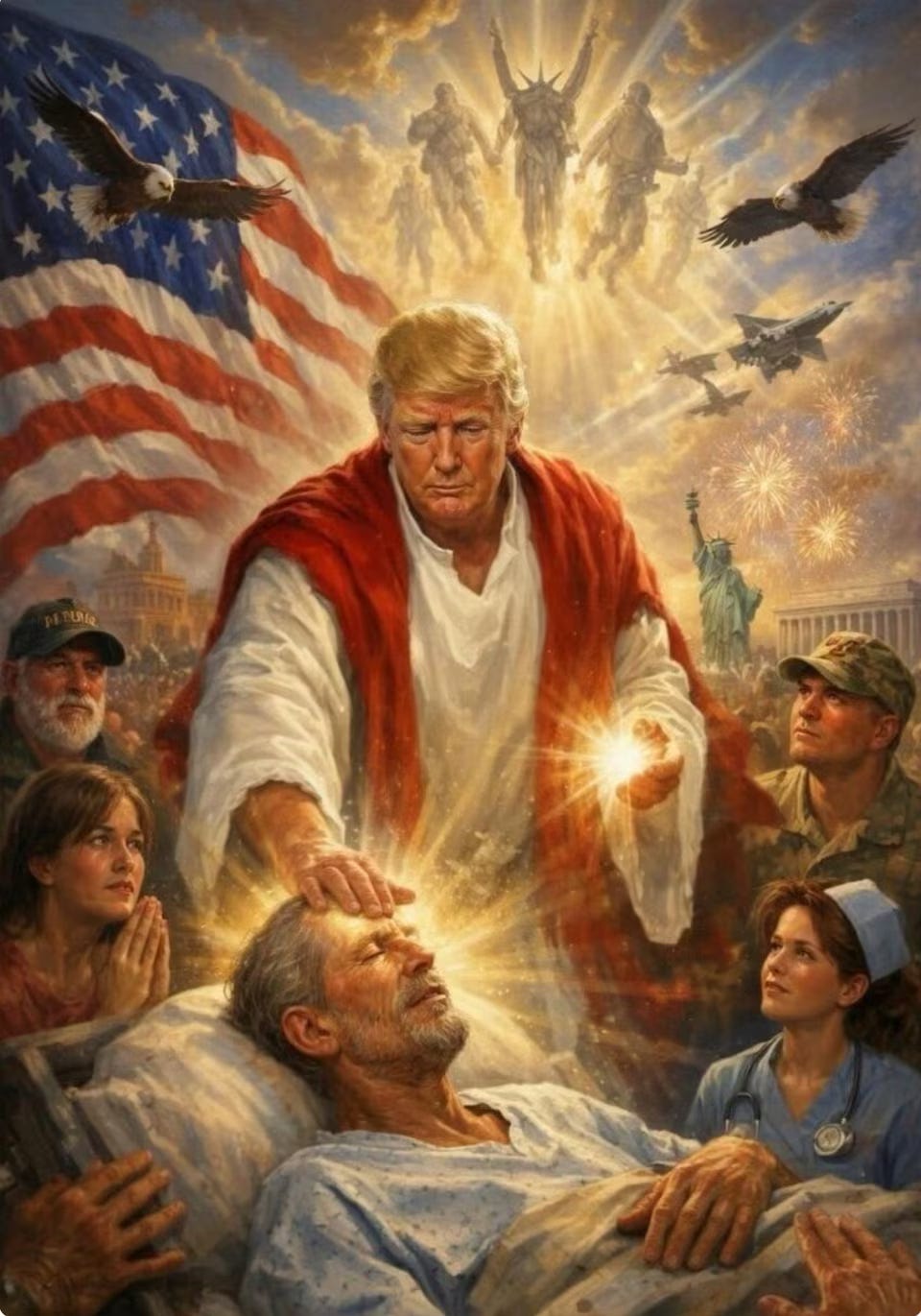
(IMAGE: A “Christ-like Trump,” published by Donald Trump himself on his social network, heals or lays miraculous hands on a man—whether an ordinary man, Christ, or Jeff Epstein, it is unclear. The comparison shows the original image, which featured the proverbial American soldiers liberating the oppressed at the point of a bayonet and a bomb. In the modified image shared by Trump, a strange figure—a cross between the Statue of Liberty and a winged demon—replaces the central figure.)
Technology as the Sole Metaphysics
Long after Kant, and degrading his interpretation into a hideous caricature, everything we witness today—for example, in the Middle East war—is the inevitable fallout of a conceptual logic woven into the very architecture of power legitimization in Western modernity: eliminating tradition, where truth is a direct revelation or intuition that can be commented upon but not deduced when it comes to final questions, only to replace it with the scientific method, which works perfectly for investigating the material world. In doing so, the comprehension of existence was materialized. Attempts to universalize this comprehension lead to a closed horizon, where technology becomes the only possible metaphysics (the investigation of Being). If this is so, it is not that there are no good or bad ideologies: it is that the very notion of thinking becomes absurd. There is nothing to think about, unless thinking is instrumental. And for that, we have artificial intelligence. It is within this framework that artificial intelligence appears “diabolical” and is intuited as such. But the problem is not the technology; the problem is the materialist framework that has made technology—as the manipulation of matter—the only horizon and the only hope for those who, in truth, are nothing but nihilists.
Political Dadaism and the Stripping of Power
Against this backdrop of ideological exhaustion, Trumpism—much like any other administration—lacks inherent meaning (technology suffices to govern a closed-horizon world). And since Trumpism is necessarily political dadaism—as we called it almost a year ago now—all it will achieve is exactly what dadaism achieved in art: no memorable work of its own, but certainly a massive destruction of prior forms. In that sense, it is fulfilling its function. Trumpism has no other purpose than to make this self-destruction manifest. It consists of carrying out the final stages of the intense madness in which Western elites have wrapped themselves in their eagerness to retain control and hegemony. In that madness, they perhaps still have moderately clear objectives, and they may have a clear grasp of their desperate means, but it is now impossible for them to argue for it in a way compatible with the supposed historical aims of Western modernity. It is a Western movement fully weaponized against the West.
It can no longer claim that what is being done is moral; it can no longer claim it is in pursuit of a “rules-based world order,” because all those rules have been trampled too many times by their very own sponsors. It can no longer claim it is “for the benefit of the population,” because the genocides, the policies contrary to their own populations, and on a global scale not only the permanent interventions with millions dead, but Covid and its crimes, are today visible to anyone willing to look at them—and many have experienced them in their own flesh, literally. Anyone not so paralyzed by the fear of the future that they actively deny it, has already seen this.
All of this is exactly the opposite of what Kant foresaw as a healthy functioning of moral restraints based on the mandatory publicity of power’s intentions. Naturally, power laughs at the philosopher, its eternal enemy: if there is one thing power has done since it came into existence, it is hiding its intentions from others.
Indeed, it is only in an era like ours—an exceptional age of decadence—that power strips itself bare, boldly declaring what it intends to do to others. I highlight, for those with the will to go and see it, the prophetic yield of the final maxims Kant includes in Appendix 2 of his work, which deals with the harmony between politics and morality. The proposition guiding it is another foundation of the political organization the modern West bestowed upon itself: “All actions relating to the right of other human beings are wrong if their maxim is incompatible with publicity.” Indeed, today’s Western democracies—the height of cynicism—sell themselves as transparent regimes. Kant then illustrates this with a discussion of several exemplary cases. There is barely a single scenario into which Trump has not stumbled, and the most notable thing of all is that, according to Kant, in none of them could Trump have proclaimed his policy without it being immediately repulsive to general morality, rendering its execution impossible.
For example, if a major nation considers it necessary to annex a smaller territory, “Has the strong nation the right to subjugate and annex the weak? It is readily seen that the strong nation cannot publicly proclaim such a maxim [...] the publicity of the maxim makes it unrealizable, a sign that it is unjust and may be so to a high degree...” Well, Trump announces he will annex Greenland, announces he has already subjugated Venezuela and made it a mere tool for his energy ends, etc. The interesting point is that Trump does not comply with the Kantian maxim. Instead, he broadcasts his foulest intentions, and such proclamation fails to generate the reaction of indignation Kant would expect. Ergo: the West has entirely lost its moral spine. Morality is no longer part of its theory of right.