
The Epstein Mirage
A manipulated portrait of power that says nothing we didn't already know, concealed behind a sex scandal that also says nothing we didn't already know

The DOJ’s release of three million new documents from the “Epstein Files” exposes the inner workings of the Deep State once again, this time in a display as chaotic as it is dubiously authentic. Western power, through its media apparatus, has manufactured “society”—that manipulated abstraction—as a set of moral rules that power itself, by definition, cannot and will not obey. This “society,” replicated in the myriad comments on social media, reinforces the model by spinning like a hamster on a wheel: the perpetual moral condemnation of others. It is a game of deception we must exit, yet the contemporary obsession with abstract “sociopolitical” imagery only blocks the way out.
Jeffrey Epstein is not what he seems. Since 2006, the media and political establishment have reduced him to a perverse pedophile—a persona constructed via legal testimonies. Following his death in prison in 2019—allegedly suicide, though theories abound—the archive has been weaponized by political factions, recently amplified even during the Super Bowl by the Democratic leadership. Yet, the sheer tangle of documents serves only to numb interpretation, rendering truth indistinguishable from noise.
The real questions remain. How did a nobody with no formal education—a college dropout who lied about his credentials—rise meteorically at Bear Stearns to become a limited partner by age 27? How did a young Epstein gain entry to David Rockefeller’s Trilateral Commission and the Council on Foreign Relations? His only listed credential at the Trilateral meeting was, absurdly, “A good guy.” How did he amass such wealth and gain power of attorney over Les Wexner’s fortune? Even more suggestive is his centrality in the web of intellectual power: Noam Chomsky, Steven Pinker, Marvin Minsky. The correspondence I have reviewed reveals not sex tourism, but conceptual and financial networking. That these luminaries orbited Epstein speaks volumes about their lack of intellectual independence.
These questions are unanswerable unless we assume an “initiation”: Epstein was placed there to serve a function. His ties to Robert and Ghislaine Maxwell, as well as Ehud Barak and the elite Jewish lobby in the US, point to a clear hypothesis: Epstein operated as an asset—if not a formal agent—of Israeli intelligence within the highest spheres of power. Like it or not, the influence of such intelligence on American politics should come as no surprise to anyone today.
The Obligation to Transgress
Crass power—money and the control of material resources—requires transgression to recognize itself. In an interview, Epstein confessed a belief in the soul, suggesting that the Western worldview accommodates everything without conflict: spirituality and obscene accumulation, faith and boundless sexual experimentation. This is the default logic of a West hurled toward materialism. The absence of faith (understood not as hope, but as an internal limit) breeds fear; fear figures a world of scarcity; scarcity compels a struggle for finite resources. Desperation in the face of this void drives the formation of exclusive cliques where initiates feel secure and superior. It is a sad compensation, but a human one. The Epstein files merely confirm what we already knew, albeit now with more clues in a hyper-manipulated environment. The details simply add to a complexity that resists the moralistic simplifications currently in vogue.
The true scandal is not the “revelations,” but the media’s effort—mainstream and alternative alike—to peddle a collective moral narrative. By preaching about what “society” ought to be, they bet on abstract reform rather than promoting inner authority and self-knowledge. To play the game of “improving the world” in the abstract is to remain enslaved to the logic of social engineering that leads, inevitably, back to Epstein’s world.
Ulysses and the Discretionary Wisdom of Power
Earthly power is genetically prior to the law and is the only force capable of making law effective. Law is the child of power; without force to apply it, it is dead letter. In times of exception, this hierarchy is laid bare: power suspends the law (a coup, the law of the jungle), revealing the “rule of law” as an illusory agreement, intelligent yet violable a piacere.
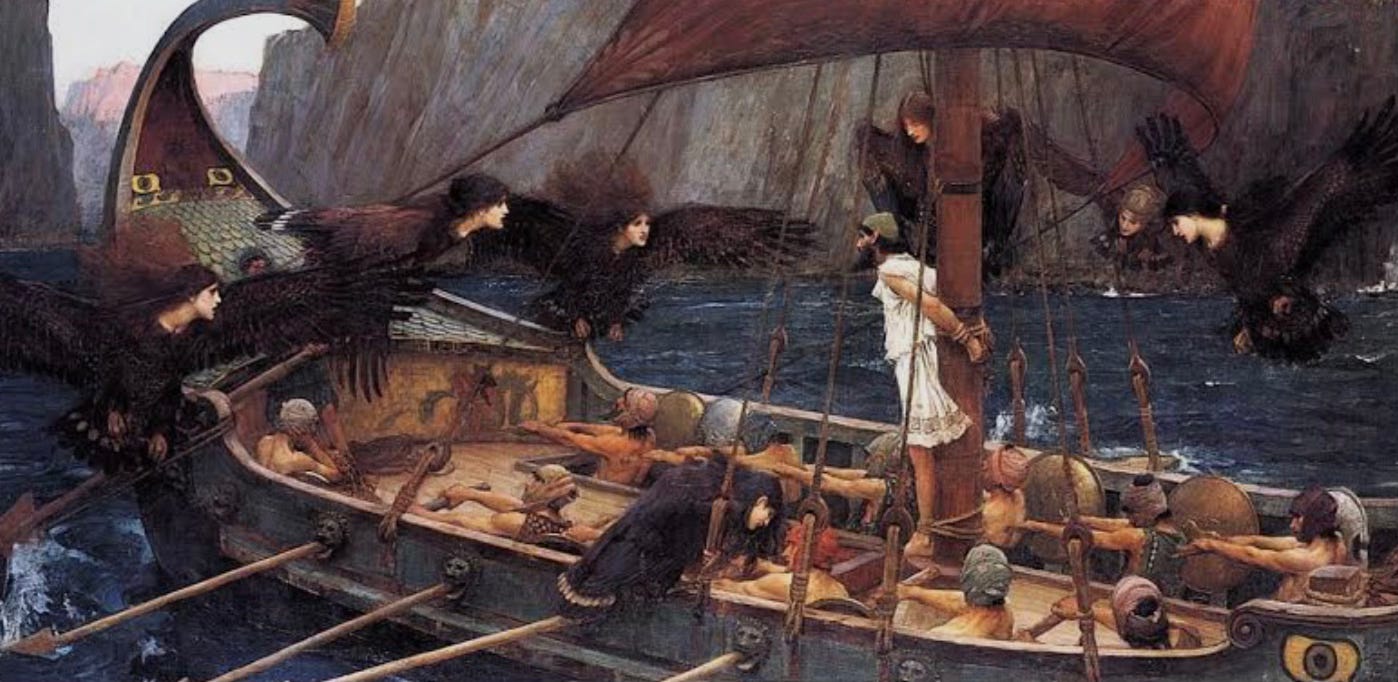
The model of voluntary self-limitation is Ulysses tied to the mast. While his sailors plugged their ears with wax, he—Power itself—chose to hear the Sirens’ irresistible song (the invitation to excess) without succumbing. Ulysses had the wisdom to operationalize his own restraint. Yet such wisdom is discretionary: power also possesses the hubris to steer obstinately toward catastrophe. If the sovereign is, as Carl Schmitt defined, “he who decides on the exception,” then the only real proof of sovereignty is absolute impunity. Rites of passage, lodges, and mystery cults are the traditional forms of this truth: the law is for the others, not for the powerful.
Power educates the masses through seduction and coercion, allowing them to feel morally superior to the elites by gossiping about their depravity. Celebrity tabloids and the Epstein files serve this function as a safety valve. Yet the allegory of Ulysses offers another reading: the reader can tie himself to his own mast, listen to the Siren songs selling moral superiority, and learn without being destroyed.
In the modern West, media communicate models of order and warnings of transgression. The implicit message is educational: “You cannot do this, but we can.” If a figure like Hillary Clinton were to participate in human sacrifice, it would be proof of her supreme power. If a nobody were caught doing the same, he would be lynched on the spot—as befits a decent society.
Seeking Confirmations That Rarely Appear
If one truly peers into the Epstein files—mindful that judicial history suggests there is more unseen material—one does not merely find the sex offender or blackmailer. Instead, one encounters an adept social operator, capable of debating the philosophical nature of deception with Peter Thiel or discussing metaphysical anguish with the Chomskys. We see a financier facilitating connections between stratospheric figures like Sultan Ahmed Bin Sulayem and Ehud Barak.
I have scoured these files for over a week, largely with boredom, searching for the grand conspiracies promised by the “alternative” press. The result is disheartening. If a conspiracy theorist finds a “Mr. X” in the files, they immediately fabricate a causal link that validates their entire worldview. It is amateurish; mere proximity proves almost nothing. Meanwhile, the mainstream press generates headlines because Epstein sent money to a hairdresser for local tabloid fixtures. So what? Epstein could have been paying for any trivial service. Provincial star-struck vanity gets a thrill from a banking brush with infamy, but it amounts to exactly nothing.
The Elon Musk connection illustrates this vacuity perfectly. For those crusading against the “Silicon Valley technocracy,” the mere mention of Musk confirms their darkest fears about AI and transhumanism. Yet, after reviewing the 1,426 mentions of “Musk,” the reality is anticlimactic. Musk emerges as an exhausted figure, replying in monosyllables and rejecting invitations. His only possible visit to the island appears to have been in the company of his wife, Talulah Riley. While Musk mentions wanting a “wild party” due to work fatigue, the correspondence is so tedious that he eventually rejects further contact and even changes his email address to escape Epstein’s spam.
Essentially, that is all there is—at least in what has been revealed. I hear from every corner that there is evidence of Musk involved in sexual scandals but, regretfully, no example has been presented. My interest is not in defending Musk, but in observing that the Epstein affair has become a media snowball confirming only trivial suspicions about the rich. Above all, the engine driving this scandal is a form of “vicarious ethics.” The millions of social media comments are not seeking justice; they are a variant of gossip, the purpose of which is to allow the commenter to feel, for a brief second, morally superior to the accused.
The Condition of Limitless Amorality
Power does not “decide” in assembly; it operates via an automatic discursive logic that its actors follow instinctively. When a member becomes radioactive—like Epstein—the system activates a cordon sanitaire. Suddenly, no one knew him; neither Wexner, nor Musk, nor Hoffenberg (the Ponzi scheme mentor) recall a thing. A narrative is crafted to shield the power structure while offering a moral fable so that “society” remains quietly in its box, feeling morally superior.
In the absence of deep-seated moral codes, the morality of utility and success reigns supreme. Epstein is simply a mirror of how many would behave if they had the means. That they do not transgress proves not their virtue. The avidity with which I hear people deploring the “immorality of the elites” is little more than a pre-filled template, recited on autopilot and void of consequence.
Perversity Hides Best in Plain Sight
The “Epstein files” are a media phenomenon fed by the prevailing millenarianism. They seek the final proof of Satanism or the supreme conspiracy, yet, upon reviewing them, one finds no such thing. Or at least, I have not found it. What remains is the confirmation of the all-too-known. Perversity is not hidden; it is a bacterium already resident in society that we attempt to pathologically isolate within a single individual. Epstein is merely the stereotype everyone wishes to confirm: the perverted tycoon, the plausible Mossad agent.
The Maxwell family fits the same mold. The father, Robert Maxwell (born Ján Ludvík Hyman Binyamin Hoch), was a media mogul and, according to former officer Ari Ben-Menashe, a Mossad asset. At his funeral on the Mount of Olives, Prime Minister Yitzhak Shamir declared that Maxwell had done “more for Israel than can today be told.” His end was equally stereotypical: he died falling from his yacht, the Lady Ghislaine, presumably while relieving himself over the side in the dead of night, just as—according to Epstein’s emails—he was attempting to blackmail other powerful figures to save his crumbling empire. His daughter Ghislaine, now a convict, simply inherited the family trade.
And? This is not the invisible. It is exactly what the majority would expect to find regarding the hidden life of extreme wealth. It is the essence of the contemporary West, exposed in plain sight for social consumption.
Yes, Pizzagate Was Real
A side note of some color: the revealed files contain myriad mentions of “pizza.” Recall the scandal stemming from the Podesta emails released by Wikileaks—one of the few truly independent sources on power’s dirty laundry, and the very antithesis of this curated Epstein dump. At the time, the Deep State media reacted with hysteria against anyone decoding the strange patterns surrounding a Washington D.C. pizzeria. The narrative was neatly sealed when the archetypal “lone gunman” entered the venue firing a rifle, blaming “conspiracy theories” for his actions. With that convenient gesture, society instantly dismissed the affair as a paranoid delusion.
Yet, the Epstein emails confirm the code. “Pizza” appears over 800 times in the most implausible contexts. Ask yourself: how often do you feel the irrepressible urge to thank a financier friend—who is not a chef—for a pizza eaten days prior? And if we are merely discussing pepperoni and cheese, why the zealous redaction of the names involved in these exchanges?
A final detail: I heard a rumor about the gunman from the D.C. pizzeria recently killed by the police in a separate incident. Just one of those things.
The Impossibility of an Immanent Moral Critique of “Society”
The filth is structural; everyone knows it. Rather than scavenging through the sordid details of the Epstein files—allegations of Satanism for which I have seen no proof—to demonstrate Western decadence, we must analyze the underlying anthropological maneuver. God is not absent from the West; the West has actively chosen to ignore Him, forging a path defined by materialism and scientism. In this worldview, the only Law is the one the individual imposes upon himself, pitting his stubborn, often ridiculous intelligence against biological reality. The Marquis de Sade, an early self-conscious sexual ultraliberal who, like Epstein, was imprisoned for his exhaustively permutated vices, proclaimed the need to torture nature. To the modern individual, nature is not a guarantor of power but a sworn enemy, precisely because it represents God’s hated limit.
Heir to Sade, modern Western society concludes that morality has no boundaries. And in a sense, this is true: in an abstract system where power and resource control are the only stakes, moral limitlessness is the only reality. A true community—Ferdinand Tönnies’ Gemeinschaft—is an organic whole bound by kinship or tradition. Ethics is a matter of scale; it requires proximity. Conversely, modern “society” (Gesellschaft)—impersonal, statistical, the scale of the megalopolis—can only offer a simulacrum of morality. Social media, the ultimate showcase for decadence, allows users to scream their virtue while lazily avoiding internal scrutiny, substituting actual deeds for the denunciation of abstract sins.
The law is often just a limit that power decides others must follow. Any radical critique must be a critique of power itself, and such criticism can only be wielded in the name of the transcendent. Like it or not, a self-evident God is the only check on earthly power. Without that anchor, everything becomes a sinister game that excludes forgiveness. The final paradox is terrible: power imposes limits on the masses by managing exceptions for itself. Power authenticates itself through transgression. Just as in adolescent gangs or the mafia, one must commit an exceptional, often violent act to belong. While there are exceptions—leaders who uphold genuine values—others are “satanic” precisely because they accept a horrific pact: committing atrocities to gain entry into a hierarchy ruled by those who committed the same horrors to ascend.
Coda: True Power and the Melting Flesh
Naturally, power is not monolithic. When I used the term here, I referred to the Epstein archetype—earthly power tied to money and resource control. Yet there are subtler, superior powers: artistic talent, charisma, spiritual force. But the supreme power is self-mastery: the power of correction and redirection. If a media outlet justifies its existence, it is only to reiterate this: the only interesting aspect of the Epstein files is that which bears no relation to them. It is about your own conscience—the capacity to respect self-imposed limits, a realm where you know everything and the rest of us know nothing.
The rest is theater designed to lecture “society”—that empty concept—on norms and transgression. It is the powerful who are bound like Prometheus to their rock, their livers eaten daily by the obligation to transgress merely to maintain their privilege. Transhumanist modernity proposes physical immortality not as a utopia, but as a project. Only a desperate consciousness boards that train: blood transfusions for eternal youth, chemicals for senile sexual gymnastics with children, and exorbitant surgeries to prop up a rotting, melting physique. It is the same pathos that convinces the young to self-mutilate in order to affirm an ego-driven self-perception against nature. They need only remember their origin to abandon this madness. But evidently, the old men of Pizzagate—those we know attend the parties—cannot. The only thing left to do is look away.